
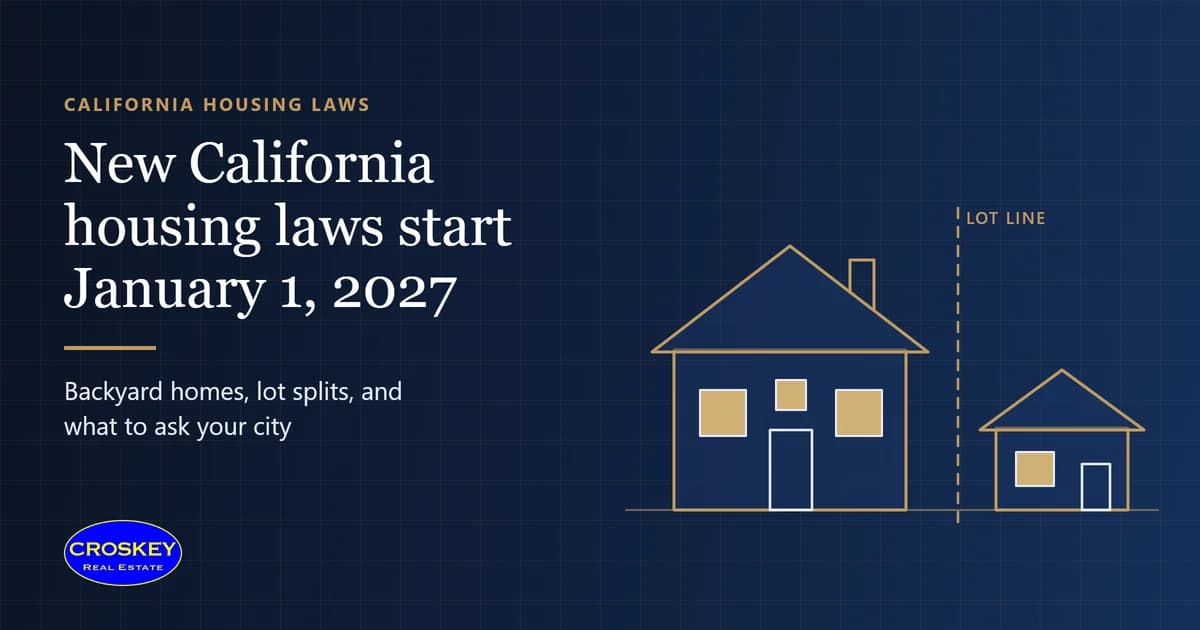
Six California housing bills signed on September 29, 2026 point to a January 1, 2027 start.
Pittsburg, Antioch, Brentwood, Oakley, Concord, Martinez and Bay Point each apply them to a given lot, so ask the city or county planning office.
Which new housing laws start on January 1, 2027?
California’s Constitution starts a law that is not an urgency law on the January 1 after a 90-day wait (Article IV of the state Constitution). Assembly Bill 956, Assembly Bill 1751, Assembly Bill 1621, Assembly Bill 2433 and Senate Bill 1117 have no urgency clause and no start date of their own, so that rule applies to them directly. It points to January 1, 2027 for bills signed on September 29, 2026.
Senate Bill 1116 (Chapter 808) has no urgency clause either, but it sets its own operative date: its lot-split changes apply to applications received on or after January 1, 2027. It also voids deed rules that block a housing project on a subdivided lot, except inside a homeowners association.
What does Senate Bill 9 let a homeowner do?
Senate Bill 9 is not one of the 2027 laws. It was signed in September 2021 (Chapter 162). It lets an owner of a lot zoned for one home add a second home or split the lot in two, without a public hearing. It lives in two Government Code sections: 65852.21 for the second unit and 66411.7 for the lot split.
A project of up to two units, which can mean adding one new unit to the home already there, is approved without a hearing. A city can set objective rules, but not ones that physically prevent two units or prevent either unit from being at least 800 square feet. It can deny a project only if its building official writes down a specific health or safety risk that cannot be fixed. The city has 60 days from a complete application to approve or deny, and a denial must come with a written list of what to fix in that time. A project the city has not decided by then is treated as approved. New units can be rented only for more than 30 days.
A lot split divides one lot into at most two, and the same 60-day clock applies. The smaller lot must be at least 40 percent of the original, and each lot at least 1,200 square feet unless the city sets a smaller minimum. The owner signs an affidavit to live in one of the units for at least three years, unless the owner is a community land trust or a qualified nonprofit. A lot that came from an earlier urban lot split cannot be split again, and the same owner cannot split the lot next door this way.
Some lots are out. Historic landmarks and contributing structures in a historic district are excluded, and so is a lot where the owner left the rental business under the Ellis Act within the last 15 years. A project cannot require tearing down or changing rent-restricted or rent-controlled housing, or a home that housed a tenant in the last three years. Lots that fail the state’s listed environmental and hazard screens are out too, and the lot must sit in an urbanized area or urban cluster as the U.S. Census defines it.
A buyer is likely to ask whether your lot can take a second home or be split. The answer comes from these rules plus the city’s own, so ask the planning office whether the lot qualifies and whether the city has its own application. The three-year affidavit matters to anyone who planned to rent out both homes after a split.
What do the three builder laws change?
Assembly Bill 1751 (Chapter 781), the Missing Middle Townhome Ownership Act, lets a builder get a townhome project approved without a hearing. A townhome here is a home of three stories or fewer that shares a wall with its neighbor. A project can have up to 150 units, and one with 11 or more units must make at least 10 percent of them affordable to lower-income buyers. A city can deny a project only on a written finding of a specific health or safety risk, and San Francisco is exempt. On a lot zoned for one home, the lot must be underutilized, meaning no permanent home stands on it unless the home is abandoned and uninhabitable. A neighbor might see rows of attached townhomes, each one sold on its own, rise on an empty or cleared lot with no public hearing first.
Assembly Bill 1621 (Chapter 780) speeds up the permit phase after a project is approved: building permits, plan check and inspections. A city can require at most two rounds of plan check. Appeals must be decided in 30 business days for projects of 25 units or fewer and 45 for projects of 26 or more, down from 60 and 90. There are exceptions. After two rounds a city can still deny a plan that does not comply, the clock pauses while another public agency finishes its own review, and a city can take longer if it writes down a specific health or safety risk. A neighbor might notice approved projects starting and finishing sooner. The bill does not change what can be built.
Assembly Bill 2433 (Chapter 800) rewrites the Density Bonus Law, the state rules that let a project add homes beyond what zoning allows when it meets listed criteria. Once an application is complete, the city must decide whether the project qualifies for the bonus. Granting a bonus or a concession is not a discretionary choice. A neighbor might see a project taller or denser than the base zoning, approved with less local discretion.
What do Pittsburg, Brentwood, Concord and Martinez say today?
As of October 29, 2026, none of the four city pages mentions the 2026 laws. Pittsburg’s answer sheet dates from January 1, 2020 and its fee schedule from July 1, 2021. Brentwood’s page cites 2019 state laws. Martinez’s page cites a 2024 law. Concord’s rebate deadline of September 30, 2026 has passed, and its main page still lists it. Ask each office what it applies today.
| City | Units on a lot with one home | Approval | Fees stated | Lot-split page | Office phone or email |
|---|---|---|---|---|---|
| Pittsburg | City answers: one attached unit plus one detached unit. | No public hearing, through the building permit. No timeline stated. | Planning fee schedule: $260 flat. Nothing on the 750 square foot line. | Ask the office | Planning: (925) 252-4824 |
| Brentwood | Handout: one attached or detached unit plus one small unit inside the home. | The handout describes staff-level review within 60 days. | City answers: no city or county impact fees on units of 750 square feet or less. | Yes: names Senate Bill 9, the urban lot split law. | (925) 516-5405, planning@brentwoodca.gov |
| Concord | Regulations: one unit plus one small unit inside the home. | Pre-approved plans: permits may be issued within five working days if documents are complete. | City answers: no impact fees under 750 square feet. | Yes: handout on Senate Bill 9 says no public hearing. | (925) 671-3152, zoning@cityofconcord.org |
| Martinez | City page: lists a unit under the city’s own rules, a unit inside the existing home, a junior unit and a new detached unit. | Building permit application. No timeline stated. | City page: units under 750 square feet are not subject to impact fees. | Yes: its own Senate Bill 9 page. The city’s page says 30 calendar days of staff review, a city step separate from the state’s 60-day decision clock. | Planning: (925) 372-3515 |
Ask the Antioch, Oakley and Contra Costa County (Bay Point) planning offices directly.
How long does a second unit permit take in Brentwood?
Brentwood’s handout says city staff review a second unit within 60 days. The city also posts a table of second unit permits, and it shows longer waits. As of October 29, 2026, none of the 11 now under construction was approved within 60 days of the application. The quickest took 64 days, the middle one 210 days and the longest 723. Another 14 applications are still waiting, with a middle wait so far of 278 days.
The table does not say why a permit took as long as it did. Some of that time goes to waiting for an applicant to answer the city’s questions, so read the numbers as a guide to timing, not as a score for the city. Eleven permits is a small group, so treat it as a sign, not a rule.
For a seller whose buyer asks about a second unit, and for a buyer who wants one, that means planning for months and asking the planning office for current timing in writing.
What does this mean if I am selling or buying?
Assembly Bill 956 allows two detached accessory dwelling units on a lot with a house, so a buyer may ask what your lot can hold. Senate Bill 1117 bases a city’s charge for certain units only on floor area above 750 square feet, so ask how your city applies that line. In a homeowners association, read the governing documents first: under Assembly Bill 956 a rule that effectively prohibits or unreasonably restricts a second unit is void on a lot zoned to allow one home.
In a look at 60 sold homes from our past listings in Pittsburg, Antioch, Brentwood, Oakley and Bay Point, listed 2021 to 2026, one had a second detached unit behind the main home: an Antioch home listed in October 2022. We do not quote a price effect because we have not found a source that shows one.
If you are buying, ask the planning office what is approved or pending near the home. The builder laws above can make projects move sooner.
Which questions should I ask the planning office?
- Does my lot qualify for two units or a lot split under Senate Bill 9, and does the city have its own application?
- What charges apply to a second unit, and how is the 750 square foot line applied to mine?
- Which rules apply to a lot-split application received on or after January 1, 2027?
- Which housing projects are approved or pending near the home I am considering?
Assembly Bill 2166, offsite housing factory financing, was vetoed on September 18, 2026, so it is not law.
Where to start
If a sale is on your mind, the sell page is where our pricing analysis begins, with sold homes on your street. Questions about your own lot can go to the real estate line at (925) 219-8488.
Sources
- California Legislative Information, Assembly Bill 956 (Quirk-Silva), Chapter 791: https://leginfo.legislature.ca.gov/faces/billNavClient.xhtml?bill_id=202520260AB956 (read October 28 and 29, 2026)
- Senate Bill 1117 (Cervantes), Chapter 809: https://leginfo.legislature.ca.gov/faces/billNavClient.xhtml?bill_id=202520260SB1117 (read October 28 and 29, 2026)
- Senate Bill 1116 (Caballero), Chapter 808: https://leginfo.legislature.ca.gov/faces/billNavClient.xhtml?bill_id=202520260SB1116 (read October 28 and 29, 2026)
- Assembly Bill 1751 (Quirk-Silva), Chapter 781: https://leginfo.legislature.ca.gov/faces/billNavClient.xhtml?bill_id=202520260AB1751 (read October 28 and 29, 2026)
- Assembly Bill 1621 (Wilson), Chapter 780: https://leginfo.legislature.ca.gov/faces/billNavClient.xhtml?bill_id=202520260AB1621 (read October 28 and 29, 2026)
- Assembly Bill 2433 (Alvarez), Chapter 800: https://leginfo.legislature.ca.gov/faces/billNavClient.xhtml?bill_id=202520260AB2433 (read October 28 and 29, 2026)
- Assembly Bill 2166 (Carrillo), status page showing the September 18, 2026 veto: https://leginfo.legislature.ca.gov/faces/billStatusClient.xhtml?bill_id=202520260AB2166 (read October 28 and 29, 2026)
- Croskey Real Estate past listings (sold), as published on croskeyrealestate.com, counted October 29, 2026
- Government Code 65852.21 (two units) and 66411.7 (urban lot split): https://leginfo.legislature.ca.gov/faces/codes_displaySection.xhtml?lawCode=GOV§ionNum=65852.21 ; https://leginfo.legislature.ca.gov/faces/codes_displaySection.xhtml?lawCode=GOV§ionNum=66411.7 (read October 29, 2026)
- California Constitution, Article IV, the section on when laws take effect: https://leginfo.legislature.ca.gov/faces/codes_displaySection.xhtml?lawCode=CONS§ionNum=SEC.%208.&article=IV (read October 29, 2026)
- City pages, all read October 29, 2026: https://www.pittsburgca.gov/services/community-development/planning/advanced-planning-special-projects/accessory-dwelling-units ; https://www.pittsburgca.gov/home/showpublisheddocument/11721/637479142624630000 ; https://www.pittsburgca.gov/home/showpublisheddocument/13086/637617053114330000 ; https://www.brentwoodca.gov/government/community-development/development-services/accessory-dwelling-units ; https://www.brentwoodca.gov/home/showpublisheddocument/3226/637864951940670000 ; https://www.brentwoodca.gov/home/showpublisheddocument/6736/638109455900970000 ; https://www.brentwoodca.gov/government/community-development/development-services/two-unit-developments-urban-lot-splits-sb9 ; https://www.cityofconcord.org/1086/Regulations ; https://www.cityofconcord.org/DocumentCenter/View/9200/ADU-FAQs ; https://www.cityofconcord.org/1075/Pre-Approved-ADU-Plans ; https://www.cityofconcord.org/1268/ADU-Rebate-Program ; https://www.cityofconcord.org/DocumentCenter/View/11575/SB-9-Information-Handout-PDF ; https://www.cityofmartinez.org/departments/planning/accessory-dwelling-units-adus-and-junior-accessory-dwelling-units-jadus ; https://www.cityofmartinez.org/services/planning/senate-bill-9-projects
This article is legal information, not legal advice, current as of October 29, 2026. Croskey Real Estate is a licensed California brokerage, not a law firm. Rules differ by city and by lot, and laws change. Confirm what applies to your property with your city or county planning office or an attorney before you act.
Frequently asked questions
When do the new California housing laws take effect?
The general rule points to January 1, 2027. The California Constitution (Article IV) says a law passed in a regular session takes effect on the January 1 that follows a 90-day wait after it is enacted, unless it is an urgency law. These bills were signed on September 29, 2026. Assembly Bills 956, 1751, 1621 and 2433 and Senate Bill 1117 have no urgency clause and no start date of their own, so the rule applies to them. Senate Bill 1116 has no urgency clause but sets its own operative date: its lot-split changes apply to applications a city receives on or after January 1, 2027. Senate Bill 9, signed in 2021, is not one of the 2027 laws.
Can I split my lot under Senate Bill 9?
Possibly. Senate Bill 9 lets an eligible owner of a lot zoned for one home split it into two lots, each at least 1,200 square feet unless the city sets a smaller minimum, with the smaller lot at least 40 percent of the original. The owner signs an affidavit to live in one of the units for at least three years, unless the owner is a community land trust or a qualified nonprofit. Historic landmarks, homes that housed a tenant in the last three years and the other listed exclusions are out, so ask the planning office whether your lot qualifies.
Can a city say no to a Senate Bill 9 project?
Only in narrow ways. A city must decide within 60 days of a complete application or the project is treated as approved, and it can deny one only on a written finding of a specific health or safety risk that cannot be fixed. It can apply objective standards, but not ones that physically prevent two units or prevent either unit from being at least 800 square feet.
Can I build two accessory dwelling units on my lot?
Assembly Bill 956 allows two detached accessory dwelling units on a lot with a house. Whether your lot qualifies depends on its size, setbacks, utilities and local rules, so ask the city or county planning office before you plan one or mention one to a buyer. Plan on months: as of October 29, 2026, Brentwood’s own permit table shows a middle time of 210 days from application to approval for second units now under construction.
Will these laws change what my home is worth?
We do not quote a price effect because we have not found a source that shows one. These laws mostly change what can be built and how fast a city must answer a builder. What your home is worth comes from sold homes on your street, which is where every pricing analysis starts.
Does my homeowners association have to allow a second unit?
Assembly Bill 956 changes two Civil Code sections so that an association rule which effectively prohibits or unreasonably restricts an accessory dwelling unit is void on a lot zoned to allow one home. Read your association’s governing documents, and ask an attorney if a rule looks like it conflicts with the new law.
- Educational Series